|

2003 First Edition. This image was scanned from my private collection
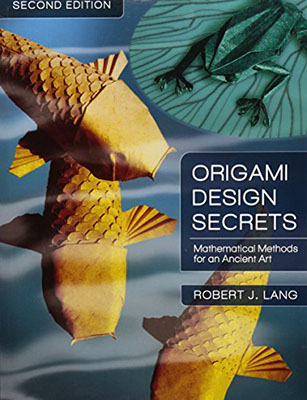
2011 Revised Edition.
TABLE OF CONTENTS
- Acknowledgments
- 1. Introduction
- 2. The Building Blocks of Origami
- 3. Elephant Design
- 4. Traditional Bases:(folding instructions for)
- Stealth Fighter
- Snail
- Valentine
- Ruby-Throated Hummingbird
- Baby
- 5. Splitting Points:(folding instructions for)
- 6. Grafting:(folding instructions for)
- Songbird I
- KNL Dragon
- Lizard
- Tree Frog
- 7. Pattern Grafting:(folding instructions for)
- Turtle
- Western Pond Turtle
- Koi(on cover)
- 8. Tiling:(folding instructions for)
- 9. Circle Packing:(folding instructions for)
- 10. Molecules:(folding instructions for)
- 11. Tree Theory:(folding instructions for)
- 12. Box Pleating:(folding instructions for)
- Bull Moose
- Black Forest Cuckoo Clock
- 13. Hybrid Bases:(folding instructions for)
- 14. Algorithms
- References
- Glossary of Terms
- INDEX
|
Title: Origami Design Secrets: Mathematical Methods for an Ancient Art
Author: Robert J. Lang
Format/Publication Date: TPB:2003; 2011(revised 2nd edition)
Publisher: A.K. Peters Ltd., Natick, MA
Page Count: 585 / 770(revised 2nd edition, w/ 26 models)
Book Dimensions(ht. x w.): 11" x 8 1/2"
ISBN: 9781568811949(2003); 9781568814360(revised 2nd edition)
SUMMARY- If you aspire to design your own models and want to learn some of the important approaches to achieve specific effects, this is a must have. Even if you Don't aspire to become a designer, reading this book and working through the examples will give you a much better understanding and improve your ability to fold more complex designs. You can spend years with this book and it would all have been well spent. Cough up the extra money and get the revised 2nd edition(I bought the 2003 edition new, I was so enchanted with it, and now he's made it even better!). I'll update this review when I can afford the revised edition.
He breaks different aspects of origami down into very digestible and approachable sections, gives you the origin of the technique if he knows it, useful examples employing the techniques presented, and explains them in simple enough language even I could understand and follow along. This is a really fascinating read and you'd better have a very large stack of paper when you sit down because you're going to want to try different things yourself as you get deeper into the book. I learned a LOT from this as a novice, and I expect I'll get a whole lot more out of it as I progress and understand more. This book is a must have.
AND he cites his sources in case you want to do a deeper dive. Dr. Lang is A++ all the way.
|