
1987 Cover. This image was scanned from my private collection
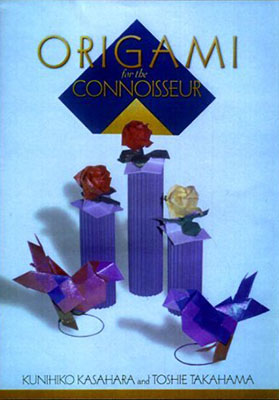
1998 Cover. This image was scanned from my private collection
TABLE OF CONTENTS
- Foreword
- Preface
- Symbols and Folding Techniques
- CHAPTER 1: The Beauty and Delight of Geometric Forms
- Logical and Lyrical
Making Froebel's Square - Hourglass
by Jun Maekawa - Rotating Tetrahedron
by Tomoko Fuse
Origami Ideal
The Meaning of Dividing
The Haga theorem
Expansion of the Haga theorem - Brain Ticklers
- Lidded Cube Box
by David Brill
Creases and Development Plans - Extraterrestrial Being
by Jun Maekawa
Folding for Identical Obverse and Reverse Surfaces - Iso-area(Obverse/Reverse) Folding Example I-
Coaster #1
by Toshikazu Kawasaki - Iso-area Folding Example II-
Coaster #2
by Toshikazu Kawasaki
The Kawasaki theorem of creasing - Iso-area Folding Example III-
Kawasaki Cube #1
by Toshikazu Kawasaki - Variation of Kawasaki Cube #1
by Toshikazu Kawasaki
Cube and Octahedron - Iso-area Folding Example IV-
Kawasaki Cube #2
Toshikazu Kawasaki - Supersonic Reconnaissance SR-71
by Toshikazu Kawasaki - Space Shuttle
by Toshikazu Kawasaki
Modular Origami - Sonobe Module
by Mitsunobu Sonobe - Simplified Sonobe Module- Bicolor Diabolo Pattern
by Kunihiko Kasahara
Exploring the Multimodular Sphere
Polyhedrons and Multimodular Sphere
Paper Sculpture from Units - Bottle
by David Brill - Regular Polyhedrons from Single Sheets of Square Paper
by Kazuo Haga
Tetrahedron(independently invented by Haga, Kasahara, and Maekawa) - The HK Cube, or Trick Dice,
independently invented by Haga and Kasahara - Octahedron
by Kazuo Haga - Icosahedron
by Kazuo Haga - Dodecahedron
by Kazuo Haga
Plan drawing for a dodecahedron
The Limitless Appeal of the Cube - The Fujimoto Cube
Shuzo Fujimoto - The Hosoya Cube- Folding Two Components and Then Assembling Them to Make a Cube
by Haruo Hosoya
Applications of the Hosoya Cube - The Tomoko Unit
by Tomoko Fuse - Rotating Ring of Cubes
by Hisashi Matsumoto - Seven Geometric Forms
by Jun Maekawa
Model No. 1 (Cubic carrying box of a traditional kind call okamochi)
Model No. 2 (Half a cube)
Model No. 3 (Once again, half a cube)
Model No. 4 (Divided masu measuring box)
Model No. 5 (semiregular decahedron with some reentrant corners)
Model No. 6
Model No. 7 (Iso-area folding) - Dodecahedron Unit
by Jun Maekawa - Octahedron Folded in the Iso-area Way
by Toshikazu Kawasaki
Preparing regular-hexagonal paper - Ptarmigan- Icosahedron
by Kohji and Mitsue Fushimi
- Logical and Lyrical
- CHAPTER 2: Creases Have Messages to Make
- Competing for the Fun of It
- Kitten
by Toshikazu Kawasaki
New Developments on Basic Patterns - Goose, Pelican
by John Montroll - Clapper Rail
by Jun Maekawa - Kangaroo, Giraffe
by Peter Engel - Malay Tapir
by Jun Maekawa - Horse
by David Brill - Fox
by Toshikazu Kawasaki - Camellia, Bloom, and Branch
by Toshie Takahama - Rose, Three Vegetables(Green Pepper, Eggplant, Daikon Radish)
by Toshikazu Kawasaki - Flower-cut Hard-boiled Egg
Toshikazu Kawasaki - Pine Cone, Spiral Snail Shell, Sea-Snail Shell, Murex Shell
by Toshikazu Kawasaki - Ground Beetle, Ramphorhynchus, Stegosaurus
by John Montroll
- Postscript